The Window of Tolerance: Understanding Your Nervous System and Emotional Balance
Learn how your body and mind work together through the Window of Tolerance — and how hypnotherapy, counselling, EMDR and breathwork can help widen it.
Alan ran down the road, trying to see if he was still being pursued. Glancing over his shoulder, he saw Barry, the psychotic serial killer, swinging an axe at him. Alan’s heart was nice and slow, and his breathing well moderated. He considered how he’d discuss last month’s sales figures with his boss. He kept running as fast as he could, realising that if Barry took just a couple more steps, there would be no meeting with the boss.
Lying on the beach, Carol felt the warm sun’s rays bathe her. She looked out over the perfect view, with no one else around. She sipped her cocktail while feeling increasingly angry at the beauty before her. Her breathing sped up, and her heartbeat increased as she realised this was her life now, since winning the lottery. Just sunbathing, cocktails and massages with the hot guys in the five-star hotel she now owned. Her focus started to pull in until all she could see were the beautiful shells on the beach that was hers and hers alone.
Something feels rather off in the stories of Alan and Carol. I don’t know about you, but if I were being chased by a mass murderer, I wouldn’t be considering banal things like meetings with my boss. And if I had won the lottery, anger wouldn’t be my expected outcome.
Why these stories feel wrong
The reason we don’t find ourselves in these strange situations is that our bodies and brains have developed great ways of making sure everything acts as it should.
When we’re in danger, we stop overthinking and start acting fast and impulsively. It’s as though our subconscious mind takes over and does whatever it can to keep us safe — running away, fighting back, or freezing.
When there’s nothing to worry about, we can relax and let our bodies get on with the background work of repair and digestion. Think about that first day off after a long, stressful week: you’re chilled, maybe a little braindead, but deeply at ease.
Introducing the Window of Tolerance
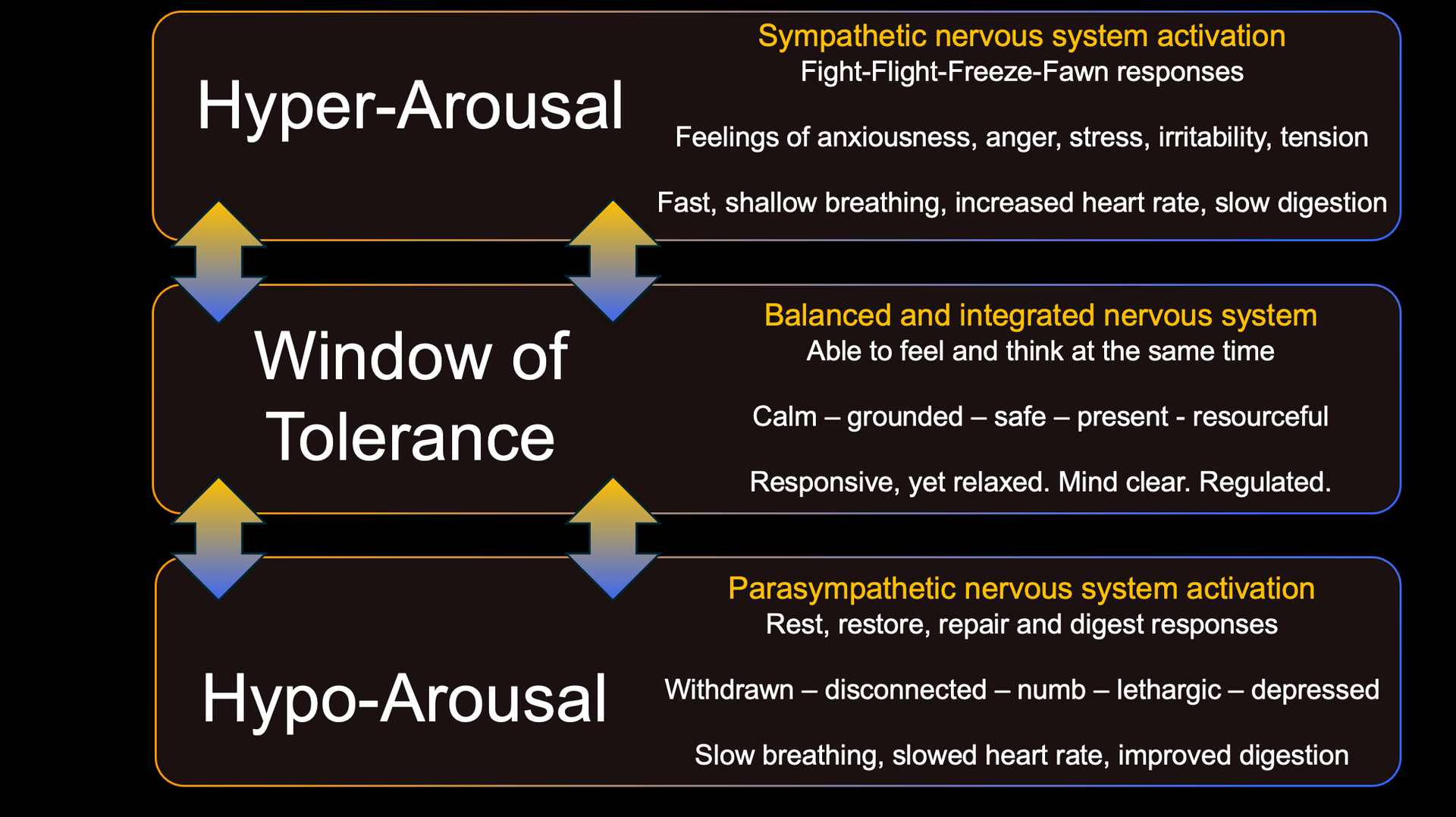
The Window of Tolerance is a model of how the body and mind respond to different levels of stimulation. It includes these two states, plus a third.
The “I’m in danger — do something now, don’t think about it!” state is called hyper-arousal.
The opposite state — “Chill out, there’s nothing to do but relax” — is called hypo-arousal.
These shifts aren’t random — they’re driven by your autonomic nervous system, the same system that regulates heart rate, breathing, and digestion.
The third state is called the window of tolerance, and we’ll come back to that.
When we’re in the wrong state
Alan — our hapless potential victim — should really have been in hyper-arousal, focused on running or fighting back.
Carol, on the other hand, should have been in hypo-arousal, slow, calm, and relaxed.
The issue with hyper- and hypo-arousal is that, as useful as they are, they don’t help us live everyday life very well. While we’re fighting or fleeing, it’s hard to think clearly. When we’re so chilled out that we’re numb or detached, we can’t connect or act effectively.
The middle way: the Window of Tolerance
The middle way is the window of tolerance. This is the state where we can think clearly.
Our bodies are ready for action — but only if it’s needed. Our minds are alert but calm enough for coherent thought. Breathing is steady, the heart rate even, and we feel safe enough to experience emotions without being overwhelmed.
Some people seem to have a very wide window of tolerance. They keep their cool in stressful situations and don’t become disconnected when things quieten down.
Others have a narrow window of tolerance — small changes to plans can throw them into a spin, or brief stillness can slide into low mood or withdrawal.
How to widen your window
Think about your own responses. Do you find yourself getting angry or scared more easily than others? Do you sometimes feel numb even in exciting situations? If so, your window of tolerance may need widening.
At Consciously Kinky, we offer several ways to help you expand that window:
Hypnotherapy allows you to explore challenging feelings — especially those that usually push you into hyper-arousal — from a calm, safe state. For example, if you get stressed thinking about presenting at work, trance can help you retrain that stress response while deeply relaxed.
Counselling helps you understand your mind more deeply — where thoughts and feelings come from, and why they persist. That self-awareness can help widen your window of tolerance.
EMDR can help stop your subconscious from triggering hyper-arousal when old memories are stirred. By reintegrating those memories, you can notice triggers without flipping into the wrong state.
Breathwork helps you move between states. Different breathing styles can either calm you or activate your system, depending on what’s needed. It also helps you notice where you are and listen to your body’s cues in the moment.
Where are you most often?
Which of these states do you find yourself in more often than you’d like?
Contact us to learn how we can help you become more regulated, balanced, and integrated — in both mind and body.